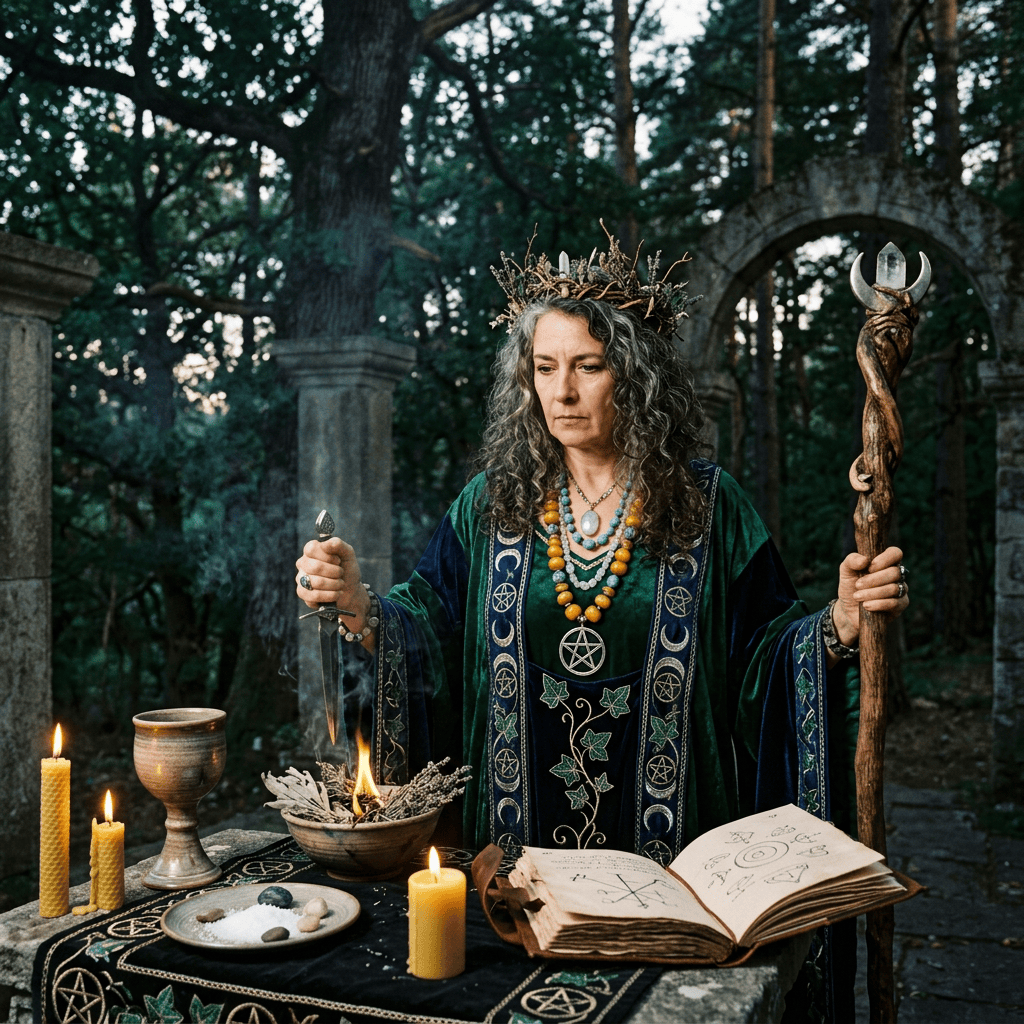
There is something that has been weighing on my mind lately, and I think it needs to be said.
If you are going to call yourself a Priestess, especially a High Priestess, and offer spiritual guidance to others, then you damn well better act like one.
The title of Priestess is not a fashion accessory. It is not something you put in your social media bio to make yourself sound important. It is not a badge of superiority, a marketing gimmick, or a way to convince others that you possess some extraordinary spiritual authority.
It is a responsibility.
And the title of High Priestess carries an even greater one.
I have spent more than two decades walking a spiritual path that has involved study, initiation, ritual, devotion, teaching, and service. If there is one thing I have learned over those years, it is that being a Priestess is not about how powerful you appear to others. It is about how you conduct yourself, particularly when nobody is watching.
A Title Does Not Make You Worthy of Respect
Respect is earned through your actions, not demanded because of your title.
I have encountered individuals who proudly proclaim themselves High Priestesses, spiritual leaders, teachers, and guides, yet their behavior is anything but priestly.
They engage in petty arguments, gossip, manipulation, jealousy, and unnecessary drama. They tear down other practitioners, belittle those who are still learning, and use their supposed spiritual authority to intimidate or control others.
Some seem more interested in being worshipped than in serving anything greater than themselves.
And I have to ask: What exactly are you a High Priestess of? Your own ego?
Being a High Priestess does not mean you are above anyone else. It does not mean your opinions are sacred law or that everyone must bow to your experience.
It means you have accepted a responsibility to lead, guide, teach, and serve.
If you cannot demonstrate humility, compassion, integrity, and accountability, then perhaps you need to reconsider what that title actually means to you.
Spiritual Leadership Is Service, Not Power
Somewhere along the way, people began confusing spiritual leadership with spiritual superiority.
A Priestess should be someone others can approach for guidance without fear of ridicule, judgment, or humiliation.
That does not mean we must agree with everyone. It does not mean we cannot establish boundaries, speak uncomfortable truths, or call out harmful behavior.
Believe me, I have no problem speaking my mind.
But there is a difference between correcting someone with wisdom and tearing them down to feed your own ego.
There is a difference between setting boundaries and being cruel.
There is a difference between standing firmly in your spiritual convictions and acting as though you are better than everyone around you.
A true spiritual leader does not need to make others feel small in order to feel powerful.
If someone comes to you seeking spiritual guidance, they are often placing a tremendous amount of trust in your hands. They may be frightened, confused, grieving, vulnerable, or simply trying to find their place in the world.
That trust should never be exploited.
Your role is not to create dependence. Your role is to help people develop their own understanding, confidence, and spiritual foundation.
Your spiritual practice should be reflected in your character, not just your rituals.
Anyone can light a candle, recite an invocation, wear ceremonial robes, or stand before an altar.
But how do you treat people when you are angry?
How do you respond when someone disagrees with you?
Can you admit when you are wrong?
Can you apologize without making excuses?
Can you celebrate another practitioner’s success without feeling threatened?
Those things tell me far more about your spiritual maturity than any title ever could.
Being a Priestess Does Not Mean Being Perfect
Now, before anyone misunderstands me, let me make something very clear.
Priestesses are human.
We get angry. We become frustrated. We make mistakes. We have bad days, personal struggles, and moments when our emotions get the better of us.
I am certainly no exception.
I can be outspoken, stubborn, sarcastic, and occasionally impatient. I do not pretend to be some perfectly serene spiritual being floating through life untouched by human emotion.
But there is a difference between being imperfect and refusing to take responsibility for your behavior.
Spiritual maturity is not the absence of mistakes. It is the willingness to recognize them, learn from them, and do better.
A High Priestess should never consider herself beyond correction or growth.
In fact, I would argue that the longer you walk this path, the more you should recognize how much you still have to learn.
The moment you believe you have nothing left to learn is the moment your ego has overtaken your wisdom.
Your Students Are Not Your Followers
This is another important distinction.
If you teach, mentor, or provide spiritual guidance, the people who come to you are not there to become extensions of your personality.
They are not there to blindly agree with everything you say.
They are not there to inflate your ego, defend your reputation, or participate in your personal conflicts.
They are there to learn.
A good teacher encourages questions. A good mentor welcomes thoughtful discussion. A responsible spiritual leader understands that students will eventually develop their own perspectives and may even choose different paths.
And that is perfectly acceptable.
The goal should never be to create people who cannot function spiritually without you.
The goal should be to help them stand confidently on their own spiritual foundations.
If your authority depends on people being afraid to question you, then what you are practicing is control, not leadership.
The Weight of the Title
For me, being a Priestess is deeply personal.
It is woven into my spiritual life, my relationship with the spirits, my ancestors, my initiatory traditions, and the responsibilities I have accepted over the years.
It is not something I put on when I want attention and take off when it becomes inconvenient.
It is something I strive to live.
And I say strive because I recognize that spiritual leadership is an ongoing process.
There is no point at which we suddenly become flawless representatives of the Divine. There is no initiation that magically removes our human weaknesses.
What initiation, experience, and spiritual responsibility should do is challenge us to become more conscious of how our actions affect others.
Being a High Priestess should make you more accountable, not less.
It should inspire humility, not arrogance.
It should deepen your commitment to service, not inflate your sense of importance.
The Bottom Line
I have tremendous respect for those who dedicate their lives to spiritual service, whether they carry the title of Priestess, High Priestess, Mambo, Houngan, clergy, elder, or teacher. These titles arise from different traditions and carry different responsibilities, but integrity should be expected of anyone entrusted with guiding others.
What I do not respect is someone using a sacred title as a shield for bad behavior.
If you want to be recognized as a spiritual leader, then lead by example.
If you want to be respected as a teacher, then demonstrate wisdom and patience.
If you want others to trust your guidance, then conduct yourself with honesty and integrity.
And if you are going to proudly announce to the world that you are a High Priestess, understand that people are going to look at more than your credentials, your initiations, your rituals, and your impressive collection of spiritual titles.
They are going to look at how you treat people.
They are going to look at how you handle conflict.
They are going to look at whether your actions match your words.
And they absolutely should.
Because being a High Priestess is not about sitting above others on some imaginary spiritual throne. It is about accepting the responsibility of serving something greater than yourself.
So wear your title proudly, if you have earned it and understand what it represents.
But remember that the title alone means very little if your behavior contradicts everything it is supposed to stand for.
If you’re going to call yourself a Priestess, especially a High Priestess, then act like one.
The spirits deserve better. Your students deserve better. And quite frankly, so does the spiritual community.

