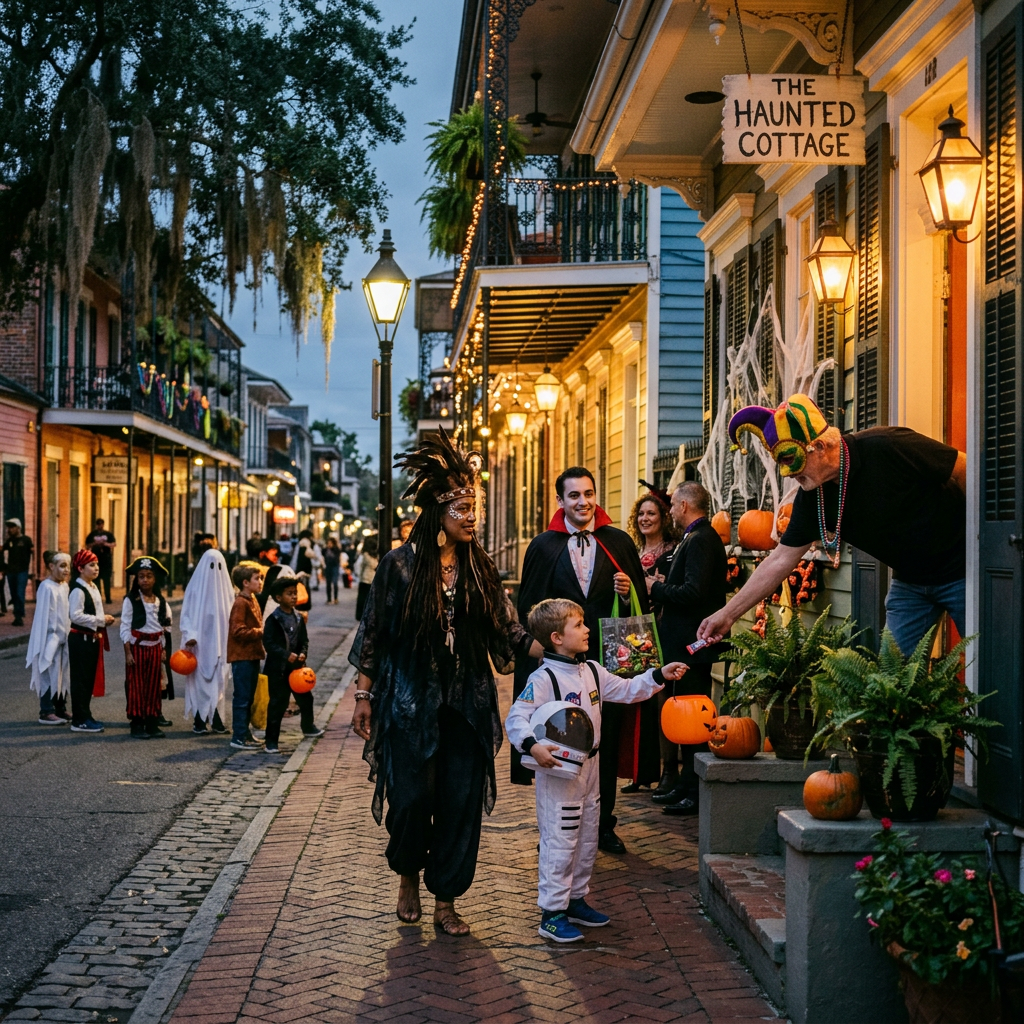
With Samhain approaching and Halloween just around the corner, costumes are everywhere. Witches, vampires, ghosts, skeletons, and all sorts of spooky characters are filling store shelves. As a lifelong Witch, I absolutely love this time of year. I enjoy the darker aesthetic, the celebration of the supernatural, and the opportunity to embrace all things strange and mysterious.
However, there are two Halloween costumes that genuinely bother me, and I think it’s time we have a conversation about them.
The first is the stereotypical Voodoo Witch Doctor, and the second, which bothers me even more, is Papa Legba, specifically the version made popular by American Horror Story.
Now, before anyone starts accusing me of being overly sensitive or suggesting that people can’t have fun on Halloween, understand something. I am not against Halloween costumes. I am not against horror movies. In fact, I love both! What I take issue with is the continued misrepresentation of a living spiritual tradition and the transformation of sacred spirits into something evil for entertainment.
The Voodoo Witch Doctor: Hollywood’s Favorite Villain
We’ve all seen the costume. A sinister-looking figure wearing a skull-covered top hat, bones hanging around the neck, a painted skull face, and perhaps carrying a staff decorated with feathers or shrunken heads. The costume is usually marketed as something dark, dangerous, and frightening.
And therein lies the problem.
For decades, Hollywood has portrayed Voodoo as something evil. It’s always the mysterious Witch Doctor casting curses, raising the dead, sticking pins into dolls, or controlling people through some sinister supernatural power.
But that isn’t what Voodoo is.
Voodoo is a living spiritual and religious tradition rooted in African ancestral practices, with different expressions and histories in places such as Haiti, Louisiana, and New Orleans. At its heart, Voodoo is about relationships with the spirits, honoring the ancestors, community, healing, and maintaining connections between the physical and spiritual worlds.
The word Voodoo itself is commonly associated with the concept of spirit.
Yes, there is magick within certain Voodoo traditions. Yes, there are rituals, offerings, and spiritual workings. But the idea that Voodoo practitioners spend their days summoning demons and inflicting suffering on unsuspecting victims is largely a Hollywood invention.
The stereotypical Witch Doctor costume reinforces these misconceptions. It takes a spiritual tradition that has already endured centuries of racism, religious persecution, and misunderstanding and turns it into a frightening caricature.
And while some people might say, “It’s just a costume,” those stereotypes have consequences.
People still genuinely believe that Voodoo is devil worship. They believe practitioners sacrifice people, worship evil spirits, and use magick exclusively to harm others. Much of that misinformation comes from the same sensationalized imagery that Halloween costumes continue to promote.
As someone who practices New Orleans Voodoo, I find that incredibly frustrating.
Papa Legba Is Not the Demon from American Horror Story
Now, let’s talk about the costume that bothers me the most.
Papa Legba.
If you’ve watched American Horror Story: Coven or 13, you probably remember the character portrayed by Lance Reddick and, most recently Orlando Jones. He appears wearing a top hat, with a painted face, dreadlocks, and an unsettling appearance. In the series, he is depicted as a sinister supernatural figure who bargains for souls and demands terrible sacrifices.
It’s an entertaining character for a horror series, but it is not an accurate representation of Papa Legba.
Unfortunately, this portrayal has become so popular that people now dress as “Papa Legba” for Halloween, often recreating the American Horror Story character without understanding who Papa Legba actually is.
And that is what I find particularly disrespectful.
Papa Legba is a revered lwa, or spirit, within Haitian Vodou and related traditions. He is associated with the crossroads, communication, and the opening of spiritual gates. In many Haitian Vodou and New Orleans Voodoo ceremonies, Papa Legba is called upon to open the way so communication with the other lwa may take place.
He is often depicted as an elderly man with a cane, sometimes accompanied by a dog, and associated with gateways and crossroads.
He is not Satan. He is not a demon. He is not some evil entity waiting to collect the souls of innocent people.
Within New Orleans Voodoo, Papa Legba is also honored, although specific teachings, imagery, and practices can vary between traditions and spiritual houses.
When I think of Papa Legba, I think of wisdom, guidance, communication, and the opening of roads. I think of a spirit who holds an important place within the spiritual traditions I have come to love and serve.
I certainly don’t think of the malevolent character presented on television.
And yet, because of American Horror Story, countless people now associate his name with evil.
That is the power of Hollywood, and unfortunately, it isn’t always a positive one.
There Is a Difference Between Fiction and a Living Religion
I want to make something very clear. I understand that American Horror Story is fiction. I understand that its purpose is to entertain, frighten, and tell a compelling story.
My issue isn’t that a horror series features supernatural characters.
My issue is that it took the name of a sacred spirit from an actual religious tradition and attached it to a character whose behavior and nature are completely inconsistent with how that spirit is understood and honored.
Imagine if a popular horror series took a revered figure from another living religion, transformed that figure into a demonic soul collector, and then people began dressing as that figure for Halloween.
There would understandably be conversations about respect, representation, and religious sensitivity.
Why should Voodoo be treated any differently?
Voodoo has spent generations fighting against misconceptions. Its practitioners have faced discrimination, ridicule, and persecution. In many cases, those prejudices were fueled by outsiders who portrayed African-derived spiritual traditions as primitive, dangerous, or evil.
The Hollywood version of Voodoo didn’t develop in a vacuum. It grew out of a long history of racial and religious stereotypes, many of which are still being repeated today.
And every time we dress a sacred lwa as a demonic Halloween character, we help keep those misconceptions alive.
But Isn’t Halloween Supposed to Be Scary?
Of course it is!
I love scary costumes. I love skeletons, graveyards, ghosts, haunted houses, and all the wonderfully creepy things that come with Halloween.
And let’s face it, my own spiritual practice includes working with the Guédé, the lwa associated with death and the dead. My altar to Maman Brigitte and Baron Samedi includes skulls, skeletons, and other imagery that many people would consider perfectly suited for Halloween.
But here’s the difference.
The imagery of death is not inherently evil, and neither are the spirits associated with it.
Baron Samedi, Maman Brigitte, and the Guédé are not simply spooky characters created to frighten people. They are spirits with complex personalities, sacred roles, and deep religious significance.
There is a tremendous difference between dressing as a fictional skeleton or a generic graveyard spirit and deliberately portraying an actual lwa as a demonic monster.
One is Halloween fantasy. The other can contribute to the misrepresentation of someone’s religion.
Respect Doesn’t Mean You Can’t Have Fun
I’m not suggesting that people should stop celebrating Halloween or that every costume needs to be subjected to some sort of spiritual approval process.
What I am suggesting is that we think about what we’re portraying.
If you love the aesthetic of the American Horror Story character, perhaps create your own fictional crossroads spirit rather than calling yourself Papa Legba.
If you enjoy the dark, mysterious look of the stereotypical Witch Doctor, consider creating a fantasy sorcerer or necromancer without attaching the costume to Voodoo.
There are countless ways to create frightening, theatrical, and elaborate Halloween costumes without turning someone else’s sacred traditions into a caricature.
And if you’re genuinely fascinated by Papa Legba or Voodoo, I encourage you to learn about them beyond what you’ve seen on television.
Read books written by practitioners. Explore the history of Haitian Vodou and New Orleans Voodoo. Learn about the lwa, the ancestors, and the traditions that have survived despite centuries of misunderstanding.
You might discover that the real spiritual traditions are far more fascinating than anything Hollywood could invent.
Final Thoughts: Our Spirits Are Not Your Horror Characters
As Samhain approaches, many of us will be honoring our ancestors, remembering those who have crossed over, and reflecting on the relationship between the living and the dead.
For me, this is also a time to reflect on the importance of respecting the spiritual traditions that connect us to those who came before.
I don’t expect everyone to believe in Voodoo. I don’t expect everyone to understand my relationship with the lwa. And I certainly don’t expect everyone to share my spiritual path.
But I do believe that living religions deserve to be represented with a certain level of respect.
Papa Legba is not the sinister soul collector from American Horror Story. Voodoo practitioners are not the evil Witch Doctors of Hollywood. And the lwa are not fictional monsters created for our Halloween entertainment.
You can love horror movies without accepting their portrayals as truth. You can celebrate Halloween without perpetuating harmful stereotypes. And you can appreciate the mysterious and supernatural without disrespecting the traditions from which those images were borrowed.
So this Halloween, enjoy the costumes, the haunted houses, the skeletons, and all the spooky festivities.
Just remember that what may be a costume to you is sacred to someone else.
And Papa Legba deserves far more respect than Hollywood has given him.

