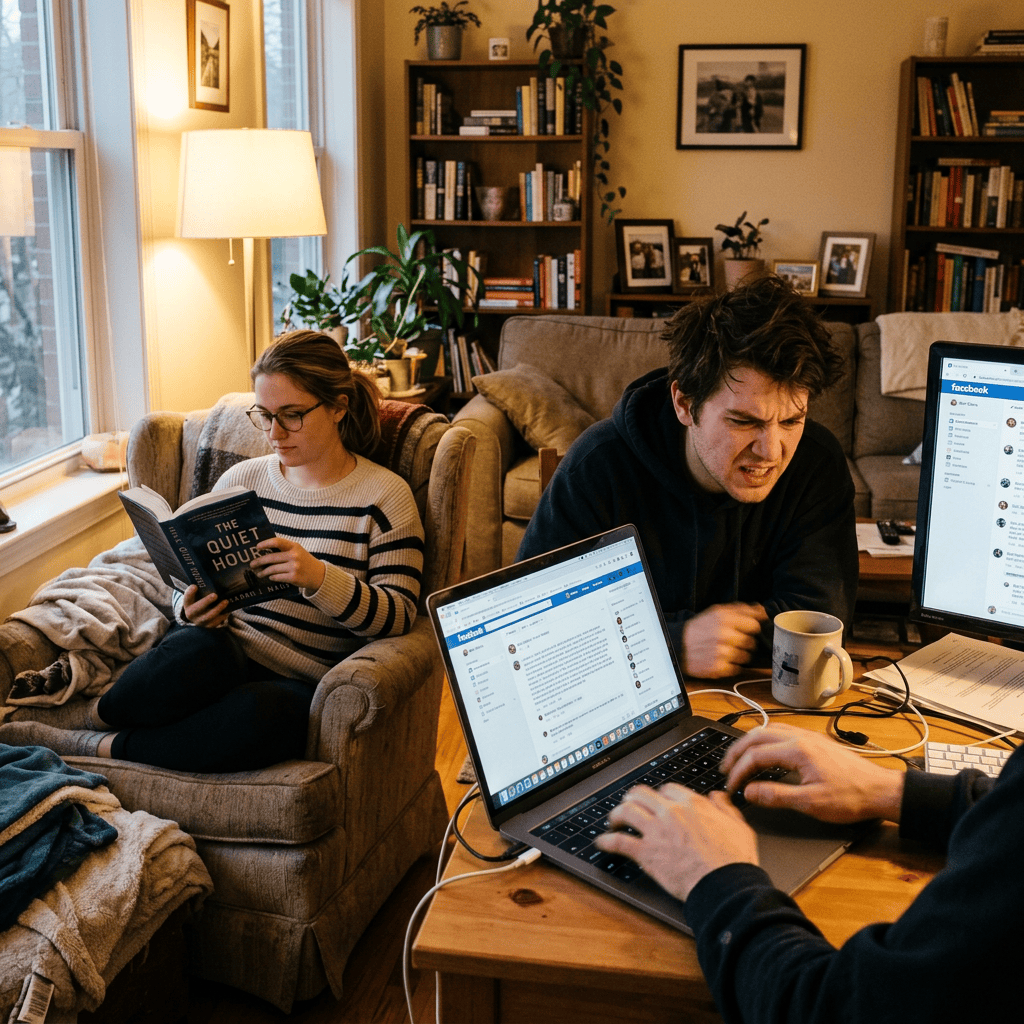
I decided to take a break from social media.
Not because I suddenly hate social media or because I think everything about it is terrible. Social media was once something I genuinely enjoyed. It was a place to connect and reconnect with people, discover new things, share ideas, promote creativity, and build online communities with people we may have never met otherwise.
Somewhere along the way, though, something changed.
Is all social media toxic? Probably not. But I can say that, from my own experience, Facebook and TikTok have become increasingly exhausting places to exist. There is an overwhelming amount of gatekeeping, name-calling, judgment, arguing, misinformation, and unnecessary hostility happening every single day.
And spiritual and religious communities certainly aren’t immune to it.
Someone makes a post about their personal religious or spiritual practice, and suddenly the gatekeepers come crawling out of the woodwork to explain why that person is doing everything wrong. Someone always seems to know the “true” way to practice. Someone knows the “correct” interpretation. Someone believes their teacher, lineage, tradition, book, experience, or opinion gives them the authority to police everyone else’s spiritual life.
There is very little room left for conversation.
Instead, everything becomes a competition over who knows the most, who has been practicing the longest, who has the right teacher, who belongs to the right lineage, who uses the right terminology, who worships correctly, who has the right ancestry, or who gets to declare themselves the Grand Poobah of whatever corner of the spiritual internet they happen to occupy.
And then there is the misinformation.
Misinformation spreads like wildfire on social media because people repeat things they have heard without ever stopping to research whether those things are actually true. One person makes a confident statement in a TikTok video, Facebook post, or comment section, and suddenly hundreds of people are repeating it as fact.
This happens constantly in spiritual communities.
One example is the way the phrase “closed practice” gets thrown around online. There absolutely are traditions, ceremonies, initiatory roles, and practices that have specific requirements for participation, and those boundaries should be respected. But social media has also created an environment where people will declare entire traditions “closed” without understanding the history, structure, or actual teachings of those traditions.
Sometimes there is considerably more nuance than “open” or “closed.”
A religion may be accessible to outsiders while particular ceremonies or priestly roles require initiation. A tradition may allow people to participate in certain devotional practices while reserving other knowledge for initiates. Individual houses, lineages, communities, or teachers may also establish their own boundaries.
Those distinctions matter.
Yet online, nuance rarely travels as quickly as a bold statement.
“This is a closed practice. Period.”
Someone reads it, repeats it, and then someone else repeats that person. Eventually, something that may have started as one individual’s interpretation becomes accepted as unquestionable fact simply because enough people have repeated it.
And when someone challenges that information or asks for historical sources, context, or clarification, the response isn’t always a thoughtful discussion. Sometimes it’s simply, “Educate yourself.”
But isn’t that exactly what asking questions is supposed to accomplish?
If someone is wrong, give them information. Give them sources. Explain the history. Explain the cultural context. Explain why a particular boundary exists and, when relevant, who actually established that boundary.
That’s education.
Repeating something you heard on TikTok isn’t research.
The same thing happens with terminology, cultural practices, folklore, witchcraft, spirits, deities, historical claims, and religious traditions. Information becomes simplified into thirty-second videos and memes, stripped of context, and repeated until people assume it must be true because they’ve heard it so many times.
Social media has given everyone a platform, but having a platform doesn’t automatically make someone an authority.
Followers don’t equal expertise. Confidence doesn’t equal accuracy. Going viral doesn’t equal being correct. And disagreement doesn’t automatically equal ignorance.
If someone posts an opinion that others disagree with, disagreement rarely seems to remain disagreement anymore. Instead of saying, “I don’t agree, and here’s why,” people immediately begin attacking the person.
Words like ignorant, dumb, stupid, and worse get thrown around casually by complete strangers who know absolutely nothing about the human being on the other side of the screen.
That is one of the strangest things about social media to me.
People see a post consisting of a few sentences and suddenly believe they know everything about the person who wrote it. They know their education. They know their experiences. They know what books they’ve read. They know what they’ve studied. They know their intentions. They know their spiritual practice. They know their relationships. They know what they believe.
Apparently, an entire human being can now be summarized by a Facebook comment.
And Gods forbid you ask a question.
Instead of assuming someone is genuinely curious or simply doesn’t know something, people often treat questions as opportunities to demonstrate superiority. Rather than educating someone, they humiliate them. Rather than saying, “Hey, here’s some information you may not know,” they immediately reach for insults.
How exactly is anyone supposed to learn in an environment like that?
If we want people to understand something, then we have to be willing to teach. If we want misinformation corrected, then provide information. If someone doesn’t understand why something is offensive, problematic, historically inaccurate, or culturally complicated, explain it.
Calling someone stupid doesn’t educate them. Calling someone ignorant doesn’t magically provide them with information.
It simply makes people afraid to ask questions.
There is also a bizarre culture of assuming that everyone should know everything happening on the internet at all times. If you haven’t heard about a controversy, you’re somehow responsible for not knowing. If you don’t know what some author, creator, influencer, priestess, witch, occultist, or random internet personality said three years ago, apparently you’re supposed to have conducted a full background investigation before liking their post or accepting a friend request.
I don’t Google every person who crosses my social media feed.
I have a life.
And that’s actually part of what made me reconsider my relationship with social media altogether.
I started thinking about how much time I was spending scrolling.
Five minutes becomes fifteen. Fifteen minutes becomes thirty. Thirty minutes somehow becomes an hour.
Then you put your phone down and wonder what exactly you accomplished during that time.
I realized that during the amount of time I was spending scrolling through Facebook or TikTok, I could have finished reading a book. I could have written several pages of one of my own books. I could have worked on a class, created something for my shop, practiced dance, spent time with my animals, watched a movie, gone outside, meditated, worked on ritual, or simply sat quietly without consuming everyone else’s opinions.
Social media has created this strange form of passive existence where we can spend hours watching other people live their lives while neglecting our own.
And somewhere between the endless scrolling, arguing, gatekeeping, misinformation, outrage, and drama, I realized something very simple:
I’m tired.
I have too much happening in my actual life to spend my emotional energy arguing with strangers on the internet.
I don’t need to debate what race someone thinks a spirit is. I don’t need to know who is fighting with whom. I don’t need to know who supposedly isn’t a “real” witch, priestess, practitioner, author, occultist, or whatever title people are fighting over this week.
I don’t need to participate in every controversy.
And I certainly don’t need to defend myself against people who have already decided who I am based on a handful of words on a screen.
There was a time when social media felt like community. Increasingly, it feels like people shouting across a crowded room while everyone waits for their opportunity to tell someone else why they’re wrong.
I don’t want to participate in that anymore.
That doesn’t mean I’m disappearing completely. Social media is an important tool for what I do. I’m an author, teacher, performer, and small business owner. It allows me to announce classes, workshops, books, events, products, performances, and other projects. It allows people who genuinely enjoy my work to find me and stay connected.
So I’m changing the way I use it.
From now on, I am using social media primarily for business, creativity, education, and sharing my work.
I’ll post about my books. I’ll share my classes and workshops. I’ll share my art, spiritual work, performances, snakes, products, and projects. But I am no longer interested in allowing social media drama to occupy space in my life that it hasn’t earned.
Not every comment deserves a response. Not every disagreement requires a debate. Not every stranger deserves access to my energy.
And not knowing about the latest internet controversy isn’t a character flaw.
Maybe the healthiest relationship I can have with social media isn’t leaving it completely. Maybe it’s remembering that social media is supposed to be a tool, not a lifestyle.
I would rather spend an hour reading than scrolling. I would rather spend an hour writing than arguing. I would rather have a meaningful conversation than participate in an online pile-on.
And I would rather live my life than constantly watch everyone else’s.
So that’s what I’m going to do.
I’ll still be around. I’ll still share what I’m creating. I’ll still promote my work and connect with the people who genuinely want to be here.
But I’m stepping away from the noise.
There is an entire life happening beyond the screen.
And I’d much rather spend my time living it.
 Cauldrons & Crossroads