WHAT IS A DARK GODDESS?
A dark goddess is not a figure of evil—she is a force of depth. She embodies the aspects of existence that many fear or avoid: death, endings, shadow, transformation, power, sexuality, grief, and truth. Where lighter or more nurturing divine forms may comfort and sustain, the dark goddess challenges, strips away illusion, and initiates profound change.
Across cultures, dark goddesses appear as guardians of thresholds—those liminal spaces where one state of being dissolves into another. They are often associated with the night, the underworld, the moon’s hidden phases, and the cycles of decay and rebirth. Figures like Kali, Hecate, The Morrigan, and Ereshkigal all embody this current in different cultural expressions. Each stands at the edge—between life and death, known and unknown, power and surrender.
To encounter a dark goddess is to be confronted with truth in its most unfiltered form. She is not concerned with comfort or appearances. Instead, she governs the necessary processes of breaking down what no longer serves. This can manifest as emotional upheaval, spiritual awakening, shadow work, or deep personal transformation. She is the force that demands authenticity—no masks, no denial, no illusion.
The “dark” in dark goddess refers to the unseen, the hidden, and the fertile void from which all creation arises. Just as seeds must be buried in darkness to grow, so too must parts of the self undergo dissolution before renewal can occur. The dark goddess presides over this sacred destruction. She teaches that endings are not failures—they are initiations.
She is also a guardian of power—particularly the kind that has historically been suppressed or feared. This includes feminine rage, sovereignty, sexuality, and intuitive knowing. Dark goddesses often reclaim what has been cast aside or demonized, reminding us that these forces are not inherently dangerous, but misunderstood and potent.
Working with a dark goddess—whether ritually, spiritually, or psychologically—often involves shadow work: facing fears, confronting trauma, and reclaiming lost aspects of the self. It is not always comfortable, but it is deeply transformative. These goddesses do not walk you around the fire; they walk you through it.
Importantly, dark goddesses are not purely destructive. They are cyclical. For every ending they bring, there is the potential for rebirth. Their power lies in their ability to hold both creation and destruction in balance. They destroy illusion, ego, and stagnation—but in doing so, they clear space for something more aligned, more authentic, and more alive.
To understand the dark goddess is to understand that true transformation rarely comes gently. It comes through confrontation, release, and rebirth. And in that process, there is a kind of sacred empowerment—one that cannot be given, only claimed.
MAMAN BRIGITTE
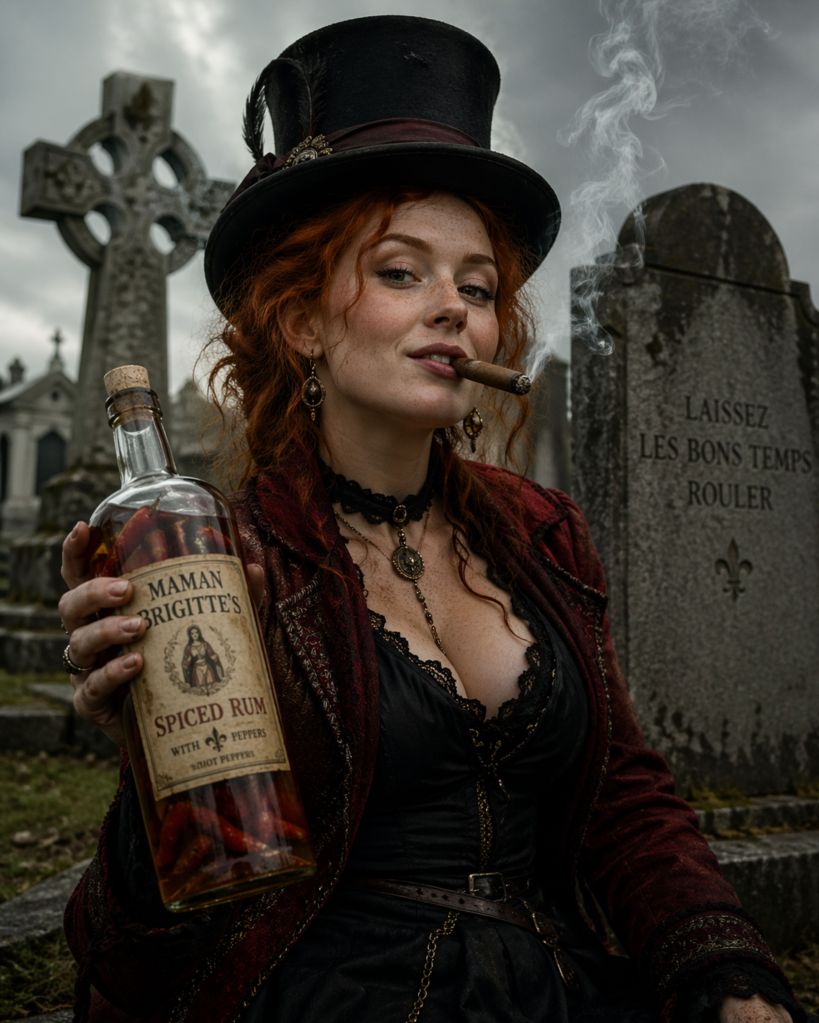
Maman Brigitte is not a gentle goddess. She is not soft, distant, or politely divine. She is raw, fierce, laughing at the edge of the grave—and it is precisely this untamed, unapologetic power that places her firmly among the Dark Goddesses.
To understand Maman Brigitte as a dark goddess is to first understand what “dark” truly means. It does not mean evil. It does not mean malevolent. Darkness, in the sacred sense, is the realm of endings, transformation, mystery, and the truths most people avoid. It is the place where illusions are stripped away and where the soul is forced to confront itself without comfort or disguise. This is where Maman Brigitte reigns.
She is the lwa of the cemetery, the fierce protector of graves, and the wife of Baron Samedi. Where he governs death with theatrical flair, she commands it with sharp wit, fire, and absolute authority. She is the guardian of those who have no one left to speak for them—the forgotten dead, the unclaimed souls, the lost. There is nothing gentle about her justice. She does not coddle. She corrects. She burns away what is false.
Her imagery alone speaks to her dark goddess nature: red hair like flame, a top hat marking her authority over death, rum infused with hot peppers that burns the throat like truth itself, and the ever-present cemetery—her sacred domain. She drinks, she smokes, she laughs loudly and often profanely, shattering the illusion that the divine must be polished or restrained. Maman Brigitte reminds us that power is not always pretty. Sometimes it is loud, irreverent, and unapologetically wild.
As a dark goddess, she is also a force of transformation. Death, in her hands, is not simply an end—it is a crossing point. She stands at the threshold between worlds, guiding souls, but also guiding the living through their own initiations. When you call on Maman Brigitte, you are not asking for comfort. You are asking for truth. You are asking for the strength to face what needs to die within you so that something stronger can rise.
She is also deeply protective, but her protection is not passive. Maman Brigitte defends fiercely, especially when it comes to injustice, abuse, or disrespect of the dead. She is known to punish those who cross boundaries, particularly those who harm others or desecrate sacred spaces. This aspect aligns her with many dark goddesses across traditions—those who wield both nurturing and destructive power, understanding that creation and destruction are inseparable.
There is also something profoundly liminal about her. Maman Brigitte embodies the crossroads of identity, culture, and spirit. With her Irish associations intertwined with Haitian Vodou, she is a reminder that the dark divine often exists outside neat categories. She is both ancestral and evolving, rooted and fluid, ancient and alive.
To walk with Maman Brigitte is to walk into the cemetery of the self—to sit among your ghosts, your grief, your shadow, and your truth. She does not ask you to be perfect. She asks you to be real. She will strip away illusion, burn through denial, and leave you standing in your raw, authentic power.
And if you can stand there—unmasked, unafraid—she will stand with you.
That is the essence of a dark goddess.
 Cauldrons & Crossroads
One response to “Maman Brigitte: A Dark Goddess”
Maybe I’m just damaged goods. But that doesn’t seem all that dark. Why shouldn’t a Goddess drink, swear, overeat, fart, oversleep, take her time, satisfy her cravings, follow her muse and take up as much, or little space as needed? Seems a fine model of femininity to me
LikeLike