There is a moment each year when the earth exhales.
It happens at Beltane, when the veil of winter has fully lifted and the pulse of life returns with undeniable force. Celebrated on May 1st, Beltane is a fire festival—one of passion, fertility, and sacred union. It is not subtle. It is not quiet. It is the season of blooming, of heat rising, of life insisting on itself.
And within this ancient celebration lives a powerful, often overlooked symbol of transformation: the serpent.
Beltane has its roots in ancient Celtic tradition, where great bonfires were lit to honor life, fertility, and protection. These fires were not just symbolic—they were portals of transformation. Cattle were driven between them for blessing, and people would leap the flames, shedding the stagnation of winter and stepping into renewal.
This is a liminal time—the space between what was and what will be.
It is the threshold of becoming.
Beltane is not just about growth. It is about ignition.
If Beltane is the fire, the serpent is what survives it.
The snake has long been revered across cultures as a symbol of rebirth, healing, and eternal cycles. Unlike other creatures, the serpent does not simply grow—it sheds. It releases what no longer serves it, sloughing off old skin to reveal something new, raw, and alive beneath.
This act is not gentle. It is friction. It is a vulnerability. It is necessary.
And that is where its magic lies.
The serpent teaches us that transformation is not about adding more—it is about stripping away.
Beltane is often associated with sacred union—the dance of masculine and feminine energies, the intertwining of forces that create life. The Maypole itself, with its spiraling ribbons, echoes the movement of the serpent: coiling, rising, weaving energy into form.
There is something deeply serpentine about Beltane energy.
It rises like kundalini, the coiled life force at the base of the spine, awakening, ascending, igniting the body and spirit. It is sensual. It is primal. It is alive.
Fire transforms from the outside. The serpent transforms from within.
Together, they create a complete alchemy of change.
Beltane invites you to ask a powerful question:
What must you shed to fully bloom?
Just as the serpent cannot grow without releasing its skin, we cannot step into our next evolution while clinging to what no longer fits.
This may be:
Old identities
Outdated beliefs
Relationships that have run their course
Versions of yourself you have outgrown
Beltane is not the time for hesitation. It is the time to burn and shed.
Write down what you are ready to release. Speak it aloud. Feed it to the fire. Feel it leave your body like skin slipping free.
Then stand in that space—raw, open, and becoming.
To walk the path of the serpent at Beltane is to embrace transformation fully.
It is to understand:
Growth is not always comfortable
Transformation requires release
Power comes from within
Rebirth is cyclical, not linear
The serpent does not mourn its old skin. It leaves it behind without apology.
So must we.
Beltane is a celebration—but it is also a challenge.
It asks you to step into the fire of your own becoming. It asks you to shed what is dead. It asks you to rise, coiled and ready, into the next version of yourself.
Like the serpent. Like the flame. Like the eternal coil.
For over twenty years, ball pythons have been part of my life — not just as animals in my care, but as constant companions and spiritual coworkers. They are more than family to me.
Like most keepers, I housed them separately. Why? Because that’s what we were all taught. The standard message echoed through forums and Facebook groups was clear: Do not cohabitate ball pythons. We were told that keeping them together would inevitably cause stress, aggression, competition, and illness. Solitary by nature. End of discussion.
But emerging research is beginning to challenge that long-held belief.
New studies suggest that ball pythons — particularly females and juveniles — may be more socially tolerant than previously assumed. In fact, research indicates that juvenile ball pythons may voluntarily cluster together, spending over 60% of their time in physical contact with one another (Skinner, M., Kumpan, T. & Miller, N., 2024). This behavior suggests that, under certain conditions, they may not be as strictly solitary as the reptile community has long maintained.
Now, first let me preface this by saying that I do continue to house my ball pythons separately. I use a rack system because, in my experience, it provides the most consistent control of heat and humidity — two of the most critical factors in proper ball python husbandry.
That said, separation does not mean isolation. All my snakes receive outside time, enrichment, and what I lovingly call “family time.” They are handled, observed, and engaged regularly. My approach has always been rooted in both practical care and deep respect for their well-being.
And yes. I have seen the infamous image of the ball python ingesting another after being together for an exorbitant amount of time. That situation was not based on housing two pythons together in a large tank. That situation was completely different.
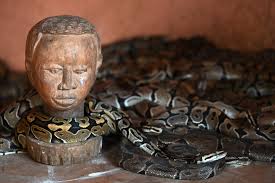
Temple of Pythons Benin, Africa
However, during my research, I was unable to find a single peer-reviewed study explicitly stating that housing ball pythons together is inherently dangerous. Instead, I was repeatedly directed to an article written by Thomas of NW Reptiles. In that piece, several references were provided regarding the physiological effects of stress — but those studies were conducted on humans. The justification given was essentially, “the studies were done on humans, but the findings apply to all animals.”
That is a broad and problematic leap.
Reptiles and mammals have fundamentally different physiological systems, stress responses, and social behaviors. While cross-species comparisons can sometimes offer insight, if research on human stress automatically applies to reptiles — without reptile-specific data — is scientifically unsound. Citing mammalian studies as definitive proof of reptile outcomes oversimplifies biology and does not constitute direct evidence.
Aside from that, the only other scholarly source I was able to locate was a 2021 study titled “Animal-appropriate housing of ball pythons – Behavior-based evaluation of two types of housing systems” (Hollandt, T., Baur, M., & Wöhr, A. C., 2021). However, this study did not address cohabitation at all. Instead, it focused specifically on comparing rack systems versus terrarium housing to evaluate which environment better supported species-appropriate behaviors.
In other words, the research centered on enclosure type — not on whether ball pythons should or should not be housed together.
As with all husbandry practices, nuance matters. But it’s fascinating — and humbling — to realize that even after decades of keeping and working with these sacred beings, we are still learning who they truly are.
And who they truly are may not be exactly what we’ve long assumed — or what we were taught to believe.
Science is not meant to reinforce dogma; it is meant to evolve our understanding. It challenges us to reexamine assumptions and refine our perspectives as new information emerges. Perhaps our long-held view of the ball python as strictly solitary deserves closer scrutiny. It may be that our collective understanding has been shaped more by repetition than by evidence — and that it’s time to look again, with curiosity rather than certainty.
The first was published on May 8, 2024: “Socially-mediated activation in the snake and social-decision-making network,” in Behavioral Brain Research. This study found that when female ball pythons were placed together in an enclosure with separate hiding spots, they did not simply remain isolated. Instead, they actively sought one another out, using scent cues to initiate social contact. Their interactions appeared to be intentional rather than incidental.
This research was followed in November 2024 by a study titled “Intense Sociability in a ‘Non-Social’ Snake,” conducted by Morgan Skinner. In this experiment, Skinner and his colleagues placed six ball pythons into a spacious enclosure for ten days, providing ample individual shelters for each snake.
Twice each night, researchers cleaned the enclosure and rotated the snakes into different hides. It was during one of these routine shelter changes that Skinner observed what he later described as a “python cuddle” — multiple snakes voluntarily choosing to rest in physical contact, even when given the option to remain separate.
Curious whether the clustering behavior was simply about the shelter itself rather than social preference, the researchers removed the shared hide. The result? The pythons regrouped and congregated under a different shelter. Their behavior suggested that it wasn’t the structure they were attached to — it was each other.
To further strengthen the credibility of the findings, Vladimir Dinets, a specialist in reptile social behavior, reviewed the study and reportedly could not identify any methodological flaws. His assessment added significant weight to the research, reinforcing the idea that these observations were not incidental, but indicative of genuine social tendencies.
Together, these findings challenge the long-standing assumption that ball pythons are strictly solitary, suggesting that under the right conditions, they may display a level of sociability previously unrecognized.
In conclusion, will I continue to house my ball pythons separately? Yes — at least until someone can convincingly demonstrate that tanks provide better overall environmental stability than the rack systems I currently use.
However, with this emerging research in mind, I can’t help but wonder: is it really so far-fetched to consider that ball pythons might benefit from occasional, carefully supervised social interaction? If studies are showing that certain females and juveniles actively seek one another out, perhaps the conversation isn’t about abandoning responsible husbandry — but about remaining open to the possibility that these snakes may be more socially nuanced than we once believed.
Maybe it’s not about rewriting everything we know overnight. Maybe it’s simply about allowing room for the idea that even a “solitary” snake might enjoy a play date now and then.
References:
Skinner, M., Kumpan, T. & Miller, N. Intense sociability in a “non-social” snake (Python regius). Behav Ecol Sociobiol78, 113 (2024). https://doi.org/10.1007/s00265-024-03535-7
Morgan Skinner, Dania Daanish, Chelsey C. Damphousse, Randolph W. Krohmer, Paul E. Mallet, Bruce E. McKay, Noam Miller Socially-mediated activation in the snake social-decision-making network, Behavioural Brain Research,Volume 465, 2024, 114965,ISSN 0166-4328,https://doi.org/10.1016/j.bbr.2024.114965.
Hollandt T, Baur M, Wöhr AC. Animal-appropriate housing of ball pythons (Python regius)-Behavior-based evaluation of two types of housing systems. PLoS One. 2021 May 27;16(5):e0247082. doi: 10.1371/journal.pone.0247082. PMID: 34043634; PMCID: PMC8158952.
Across cultures, across centuries, across the veil between worlds—the serpent has always been a messenger.
Snakes appear where transformation is imminent. They emerge when old skins no longer fit, when wisdom must be embodied rather than merely learned, and when power asks to be held with reverence instead of fear. To walk with the serpent is not a passive path; it is an initiatory one.
In spirituality, the snake is a symbol of death and rebirth, liminality, healing, erotic life force, ancestral memory, and divine wisdom. It moves between worlds—earth and underworld, conscious and unconscious, life and death—without apology. The serpent teaches us how to shed without shame and how to claim power without domination.
The Call of the Serpent
Being called to work with snakes is not about fascination alone—it is about recognition.
For many, the call arrives through repetition: recurring dreams of snakes, an unexplainable draw to serpent imagery, a sense of calm rather than fear in their presence, or a deep resonance with themes of transformation and shadow work. The serpent does not whisper—it coils itself around your life until you pay attention.
When the serpent calls, it often signals:
A period of profound personal transformation
A need to shed old identities, wounds, or imposed narratives
An awakening of intuitive, psychic, or embodied wisdom
A reconnection to ancient, chthonic, or ancestral currents
A reminder that power lives in the body—not just the mind
This is not light work. Serpent paths demand honesty, humility, and the willingness to sit with discomfort long enough for it to alchemize.
Walking the Path of the Snake Priestess
As a Snake Priestess, my work is not symbolic—it is lived, embodied, and relational. I work with snakes physically, spiritually, and energetically. They are teachers, guardians, mirrors, and allies. Through them, I’ve learned patience, presence, and the sacred intelligence of stillness.
The serpent teaches that power does not rush. It waits. It listens. It strikes only when necessary.
My priestess work is rooted in honoring serpents as sacred beings—keepers of wisdom who remind us that the divine is not always found in the heavens, but in the soil, the bones, the breath, and the slow coil of becoming.
A Message from the Guides
This morning, I donned my cobra skin necklace (shed, of course) and my snake ring. I didn’t plan it. I simply felt the need to wear them—an instinctual knowing rather than a conscious decision.
When I got into my car, something unmistakable happened.
Not one—but two serpent songs played back-to-back on my Spotify playlist.
There are no coincidences on the serpent path.
This was a nudge from my spirit guides, a confirmation and a reminder: Stay the course. The serpent energy is active, present, and speaking. When symbols align so clearly, it is an invitation to listen—not with the mind, but with the body and the soul.
The message was simple and powerful: embody your wisdom, honor your calling, and trust the shedding process. What is falling away is meant to. What remains is sacred.
Answering the Coil
To work with snakes spiritually is to accept that growth is cyclical, not linear. It is to understand that rebirth often requires discomfort, and that transformation is rarely gentle—but always purposeful.
If the serpent is appearing in your life, ask yourself:
What am I being asked to shed?
Where am I being called to step into my power more fully?
What ancient wisdom is stirring within me?
The serpent does not call everyone—but when it does, it means you are ready.
And once you answer, you are never quite the same again.