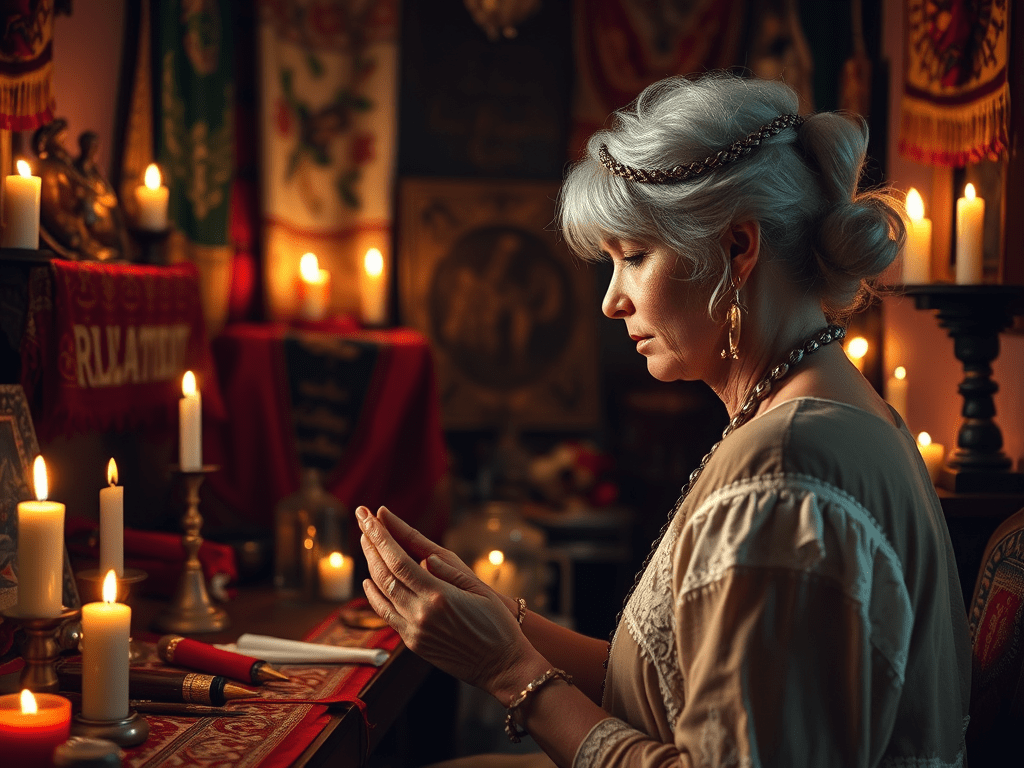
I am a white woman who practices New Orleans Vodou.
That sentence alone is often enough to invite judgment, assumptions, and criticism from people who do not know me, my teachers, or the depth of my commitment to this tradition. So I want to speak plainly, honestly, and with humility about who I am, how I practice, and what I stand for.
I am currently in my initiatory process under Mambo Samantha Corfield, within the House of the Nine Mysteries, a legitimate New Orleans Vodou house. My relationship to this tradition is not casual, aesthetic, or performative. It is devotional, disciplined, and rooted in lineage, accountability, and service to the spirits.
New Orleans Vodou is a living tradition with deep African, Afro-Caribbean, and Creole roots. Those roots matter. They must be honored, protected, and respected—not erased, diluted, or rewritten for comfort or popularity. I fully acknowledge that this tradition was forged through enslavement, resistance, survival, and ancestral endurance. I do not separate Vodou from its history, nor do I attempt to claim ownership over something that does not belong to me.
What I call Vodou Witchcraft is my own personal spiritual framework—one that I created to describe how I integrate my long-standing background in modern Witchcraft with my ongoing, formal training in traditional New Orleans Vodou.
Vodou Witchcraft is not New Orleans Vodou.
It is not a replacement for it.
It is a personal path that exists alongside my initiatory work, not in place of it. It allows me to remain honest about where I am learning, where I am obligated, and where my personal Witchcraft practice continues to live. My Vodou practice is guided by my house, my elders, and my spirits. My Witchcraft practice is my own. Vodou Witchcraft is the name I use for the intersection of those two paths within my personal spiritual life.
I walk this path with humility. I listen more than I speak. I learn before I teach. I respect what is not mine to share. And I remain accountable—to my elders, my house, my spirits, and my conscience.
I am not unaware of my critics.
There are those who believe that Vodou should only be practiced by people of a specific race, and I understand where that pain and protectiveness comes from. Cultural exploitation and spiritual theft are real harms, and they deserve to be named and challenged. But it is also historically and presently true that New Orleans Vodou has always included people of different races within its houses and priesthoods.
There are white practitioners and clergy who have walked this path with integrity, including respected Mambos such as Mambo Komande and Sally Ann Glassman. Their presence does not erase the Black roots of Vodou; it affirms that Vodou is a house tradition, where calling, training, and acceptance are determined by the spirits and the house—not public opinion.
I do not practice in a disrespectful manner.
I do not bypass elders.
I do not remove Vodou from its cultural and historical context.
I do not claim titles I have not earned.
And I do not speak over the voices of those whose ancestors carried this tradition through oppression and survival.
Vodou is not something I dabble in.
It is something I serve.
Vodou Witchcraft, as I practice it, is about transparency, devotion, and ethical responsibility. It is about naming my personal spiritual synthesis honestly while honoring the integrity of New Orleans Vodou as its own sacred, rooted tradition.
You do not have to agree with my path.
But you should understand that it is grounded in humility, lineage, and reverence—not ego, aesthetics, or appropriation.
I stand by my teachers.
I stand by my house.
And I stand by the spirits I serve.
 Cauldrons & Crossroads